Clock Mesh
Every topology so far, the single wire that fails and the H-tree that fixes it by symmetry, shares one structural property: from the source to any given flop there is exactly one path. That is what makes it a tree. Trees are efficient. They are also fragile in a specific way. If any one branch’s delay is off, from a placement quirk, a buffer that was not sized quite right, or an asymmetry a real floorplan forced onto an otherwise balanced design, every leaf downstream inherits the error and no other path exists to average it out.
A clock mesh removes that fragility by removing the “exactly one path” property entirely.
The structural difference
Instead of a branching tree, a mesh is a grid of clock wires shorted together at every intersection, driven from several points at once rather than from one root.
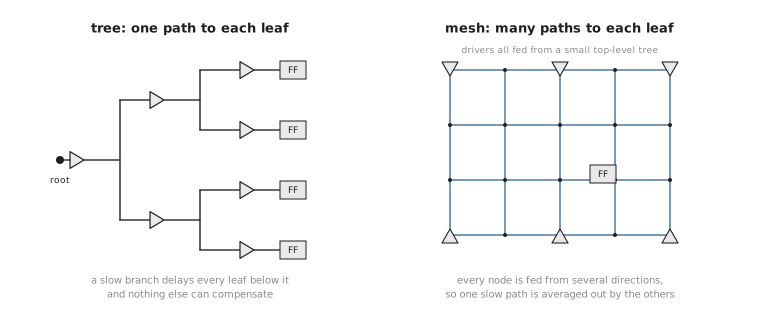
Because every mesh node is fed from multiple directions by multiple drivers, a local delay imperfection on any one branch is electrically averaged out by the other paths feeding the same node. The mesh behaves almost like a single low-impedance surface for the clock rather than a chain of independent branch delays that add up. That is what lets a well-designed mesh reach skew numbers a tree, however carefully balanced, generally cannot match. The same averaging makes a mesh more tolerant of on-chip variation, the fact that not every transistor and wire on a manufactured die behaves like its neighbour. A tree’s skew is only as good as its worst branch under variation. A mesh degrades much more gracefully, because no single branch fully determines any leaf’s latency.
The cost
None of it is free. A mesh needs dramatically more metal than a tree covering the same area: many more wires in a dense grid, all tied together. More metal means more capacitance to charge and discharge every cycle, which means meaningfully more dynamic power spent purely on clock distribution. It also consumes routing resources (Module 6) that would otherwise carry signal nets, which creates exactly the kind of congestion Module 4 warned about.
Tree and mesh side by side
| Property | Clock tree | Clock mesh |
|---|---|---|
| Paths per leaf | Exactly one | Several, redundant |
| Typical achievable skew | Good, tunable | Excellent, often the tightest available |
| Routing resource cost | Low to moderate | High |
| Power cost | Lower | Higher, more capacitance switched every cycle |
| Tolerance to on-chip variation | Limited by the worst branch | Better, through path averaging |
| Typical use | Most digital ASICs, including this course’s UART | High-performance CPU cores, FPGA global clock networks, designs with very tight skew budgets |
For the overwhelming majority of digital ASIC work, including every hands-on lab in this module, a well-built tree is the right tool, which is why TritonCTS builds trees and not meshes. Mesh appears when the skew budget is tight enough, or the frequency high enough, that a tree genuinely cannot get there. Tighter skew is not automatically better. For a design whose budget a tree already satisfies, a mesh adds power and routing cost for no timing benefit that was needed. Reach for it because a specific requirement demands it, not by default.
Practice Exercise
Would you expect a low-power IoT sensor chip, targeting minimal area and minimal standby power, to use a clock tree or a clock mesh? Justify the answer with at least two rows of the table.
Solution
A tree. Two supporting rows: power cost, since a mesh’s extra switched capacitance directly conflicts with a low-power design’s core goal, and routing resource cost, since a sensor chip is typically small and area-constrained and a mesh’s dense grid would consume routing this class of design cannot spare. Nothing about a simple sensor chip’s skew requirements justifies paying the mesh’s price. A well-tuned tree is more than adequate.
Both trees and meshes need one more physical ingredient this article has glossed over. The wires themselves eventually need help staying electrically healthy over long runs. The next article covers why: buffer insertion along the tree.