Open-Source Shuttle Programs, Historically
In the last section we produced a signed-off GDS and a report that says GO. Between a file on your laptop and a chip in your hand there is a submission process. For much of the open-source silicon movement in recent years, that process was an open multi-project wafer (MPW) shuttle. In this article we look at how those shuttles work and what they expect.
Why share a wafer
A mask set is expensive, far too expensive for a hobby project, a student design or a small research group to pay for alone. A multi-project wafer spreads the cost: many unrelated designs from different teams share the masks and the wafers of one fabrication run. Each team gets a small user project area, a fixed rectangle inside a shared die, rather than a die of its own.
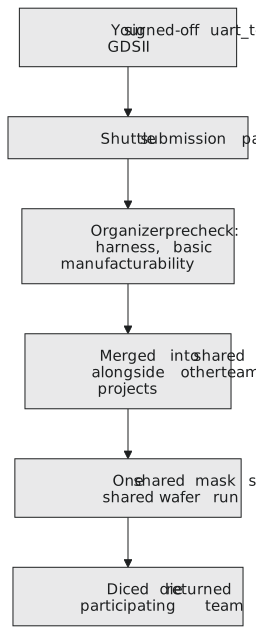
This is the model Google, SkyWater and Efabless used for the SKY130 process this course has targeted: free, open shuttle rounds that accepted open-source designs from anyone, placed them into a common chip harness called Caravel, and fabricated the result. Those shuttles got a very large number of open designs to silicon. Efabless closed in 2025, and community efforts such as Tiny Tapeout moved to other routes to fabrication, while other foundries, IHP with its open 130 nm SiGe PDK for example, run their own open shuttles. The programs change; the model of shared masks, shared cost and independent designs stays the same. Figure 1 shows the path from your GDS to a returned die.
What a submission requires
The details differ between programs, but a submission typically needs:
- The finished GDS, which is what Sections 9.1 to 9.3 produced, fitting inside the fixed user project area.
- A design that connects to the shuttle’s harness in the required way: fixed pin positions, power connections and a wrapper cell the whole shared chip is built around.
- A description of the project: name, author, licence, and what the pins do.
- A clean pass through the organiser’s precheck, which typically runs the same kinds of checks this course covered, DRC, LVS against the harness, antenna and density, often with the same open-source tools.
Suppose a shuttle’s submission window closes in three weeks. Using the checklist from Section 9.3, a reasonable pre-submission plan looks like this:
- Every signoff checklist item is PASS, or has a written, signed waiver where waivers are allowed.
- The design fits the user project area with margin and connects to the harness as specified.
- The project description is complete and matches the design.
- The organiser’s precheck has been run locally and comes back clean.
- The package is uploaded several days before the deadline, leaving time for at least one resubmission if the official precheck flags something.
Shuttle prechecks are usually open source and can be run locally, precisely so that a team can find a blocking DRC problem days before the deadline instead of after the organisers’ queue reaches their submission.
A mistake to avoid is treating a passing precheck as the same thing as your own signoff. A precheck confirms that your project fits the shared harness and will not endanger the shared masks. It says nothing about whether your design works or meets timing. That responsibility never leaves the submitter.
Practice Exercise
Why does the multi-project wafer model make economic sense for hobby, academic and research designs, but not for a company shipping millions of units of one chip?
Solution
Sharing mask cost only makes sense when a handful of returned chips per project is the goal, which is the case for prototypes, teaching and research, where proving the design works is the point. A company shipping in volume needs whole wafers of its own chip, with a die size and wafer layout optimised for that one product, and it cannot share masks with unrelated projects or wait for a shuttle’s schedule. The MPW model trades cost per chip and control for a very low entry cost and shared risk, a trade that suits small, one-off projects and works against volume production.
In the next article we follow the GDS further, to what the mask shop and the fab physically do with it.