Module 8: RTL Coding for Quality & Synthesis
Module 7 finished with RTL that is correct, fast, safe across clock boundaries and power-aware. A question worth asking honestly at this point: if you handed your best RTL from Module 7 to a colleague tomorrow with no explanation, how long would it take them to trust it? Not to understand it eventually, but to trust it the way you trust code you did not write, in a design review, under a deadline.
If the answer is “a while”, this module is for you. Nothing here is about writing more correct RTL; you have had that since Module 5. This is about the four qualities that turn correct RTL into RTL a team can build a chip on: a style consistent enough that patterns are recognised at a glance, an understanding of synthesis deep enough that you are not surprised by what comes out, enough timing analysis to know whether the design will actually run at the clock you designed it for, and a debugging method that converges instead of wandering.
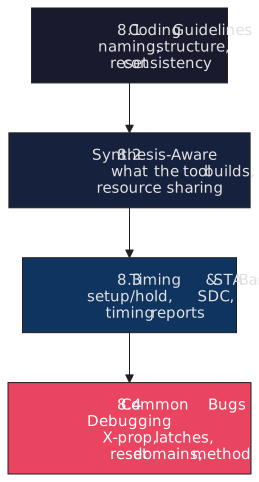
Section 8.1 is about the RTL before synthesis touches it: the conventions that make a codebase legible to a team rather than only to its author. Section 8.2 opens up the synthesis tool conceptually, so the choices from 8.1 stop being preferences and start being informed by what happens to the code on the other side. Section 8.3 gives you enough static timing analysis to read the report the tool hands back and know whether you met your clock. Section 8.4 closes with the debugging method that ties the three together, because eventually something will fail, and how you approach that failure matters as much as the discipline that was supposed to prevent it.
Objectives by section
| Section | You will be able to |
|---|---|
| 8.1 Coding Guidelines & Style | Apply consistent naming and file organization, keep reset strategy consistent across a design, avoid the RTL patterns that cause simulation/synthesis mismatches |
| 8.2 Synthesis-Aware Coding | Predict the gate-level structure a synthesis tool builds from common RTL idioms, understand resource sharing and its area/timing tradeoff, write RTL that guides the tool instead of fighting it |
| 8.3 Timing Constraints & STA Basics | Explain setup/hold timing paths and the critical path, write basic SDC constraints, read a synthesis timing report and identify a failing path |
| 8.4 Common RTL Bugs & Debugging | Diagnose X-propagation, unintended latch inference, reset domain problems, and multi-driver conflicts, and apply a systematic simulation-to-RTL debugging methodology |
Estimated time
| Section | Posts | Reading and exercise time |
|---|---|---|
| 8.1 Coding Guidelines & Style | 3 | ~36 minutes |
| 8.2 Synthesis-Aware Coding | 3 | ~40 minutes |
| 8.3 Timing Constraints & STA Basics | 4 | ~56 minutes |
| 8.4 Common RTL Bugs & Debugging | 5 | ~65 minutes |
| Total | 15 | ~197 minutes |
Section 8.1 starts with a question that has nothing to do with clock frequency or gate count: why does the same reset signal turn up spelled three different ways in a design that three engineers touched? The answer is almost never “because it had to”, and fixing it is the cheapest quality improvement in this module. Start with 8.1 RTL Coding Guidelines and Style.